The Radical Font
Eric Lengyel • February 27, 2026
The Radical Pie equation editor ships with a special font that’s unsurprisingly named Radical. This font started out as a way to provide a few extra symbols that didn’t exist in Unicode and to correct some subtle errors in the old Symbol font. As the need increased for more and more mathematical symbols with a look and feel consistent with the Times and STIX font families, the Radical font grew much larger in size. When Radical Pie 1.0 shipped, there were a total of 760 glyphs in the font. As of version 1.6, the latest version when I wrote this, the count is 1017.
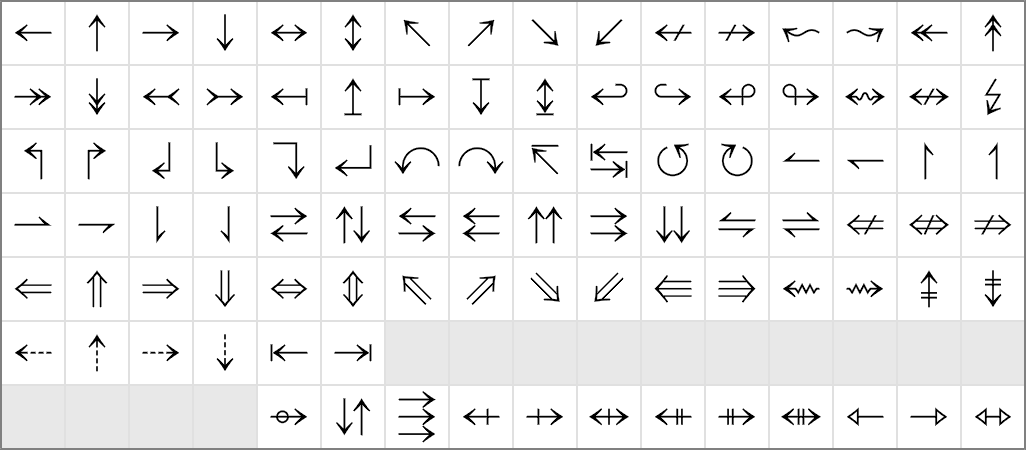
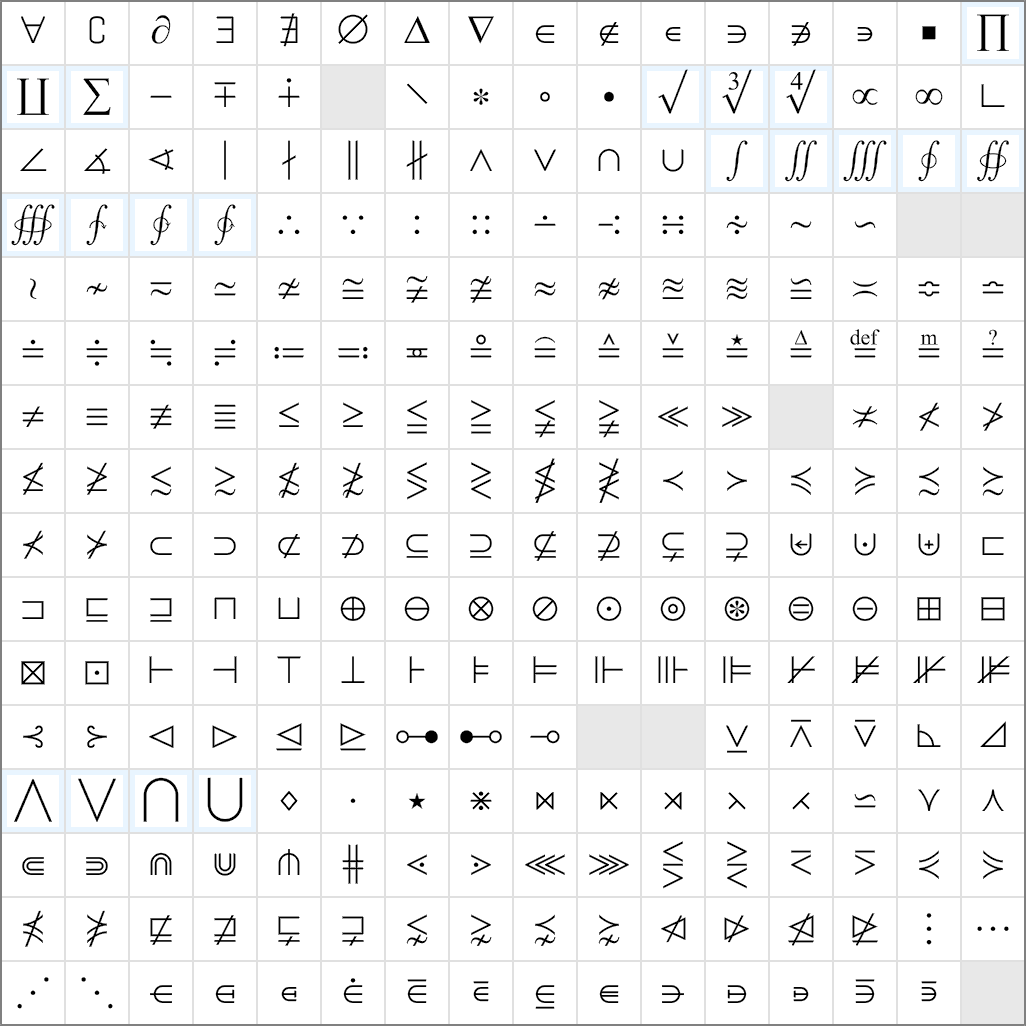
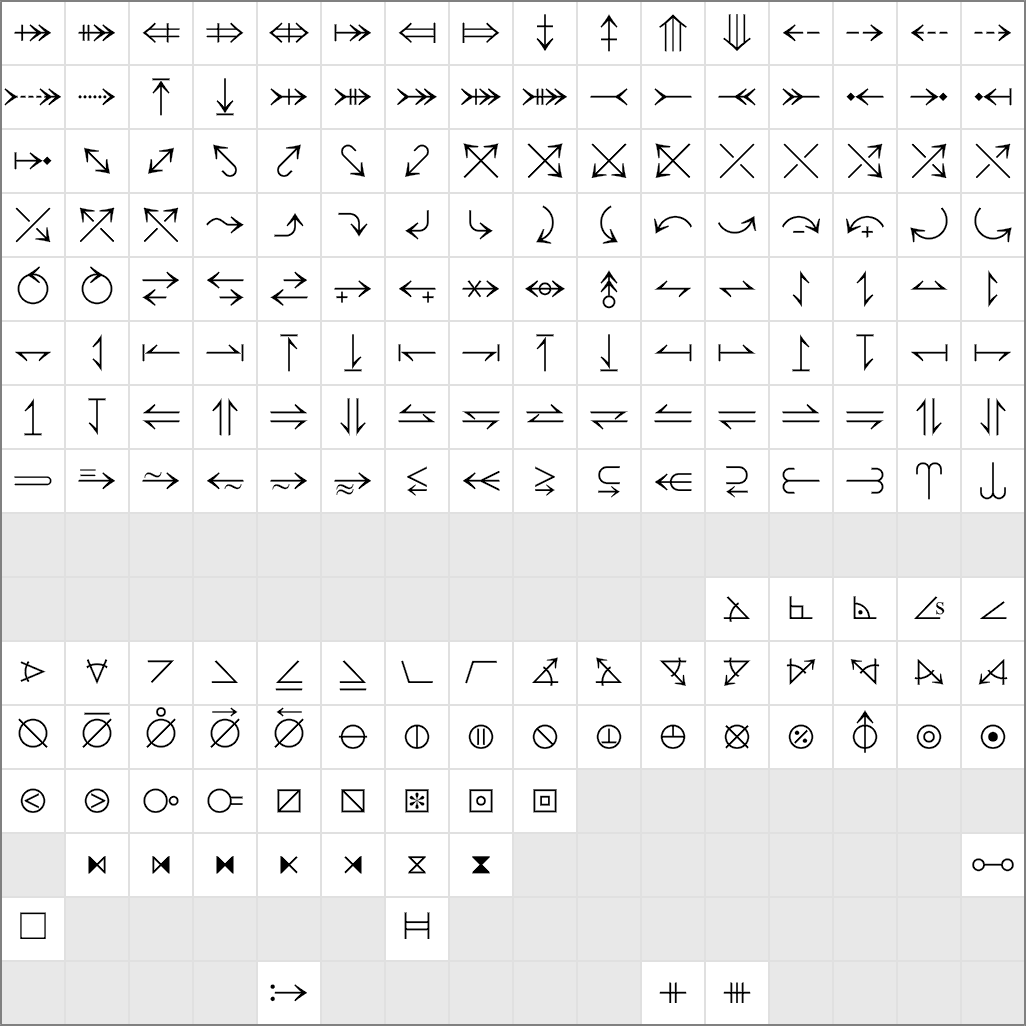
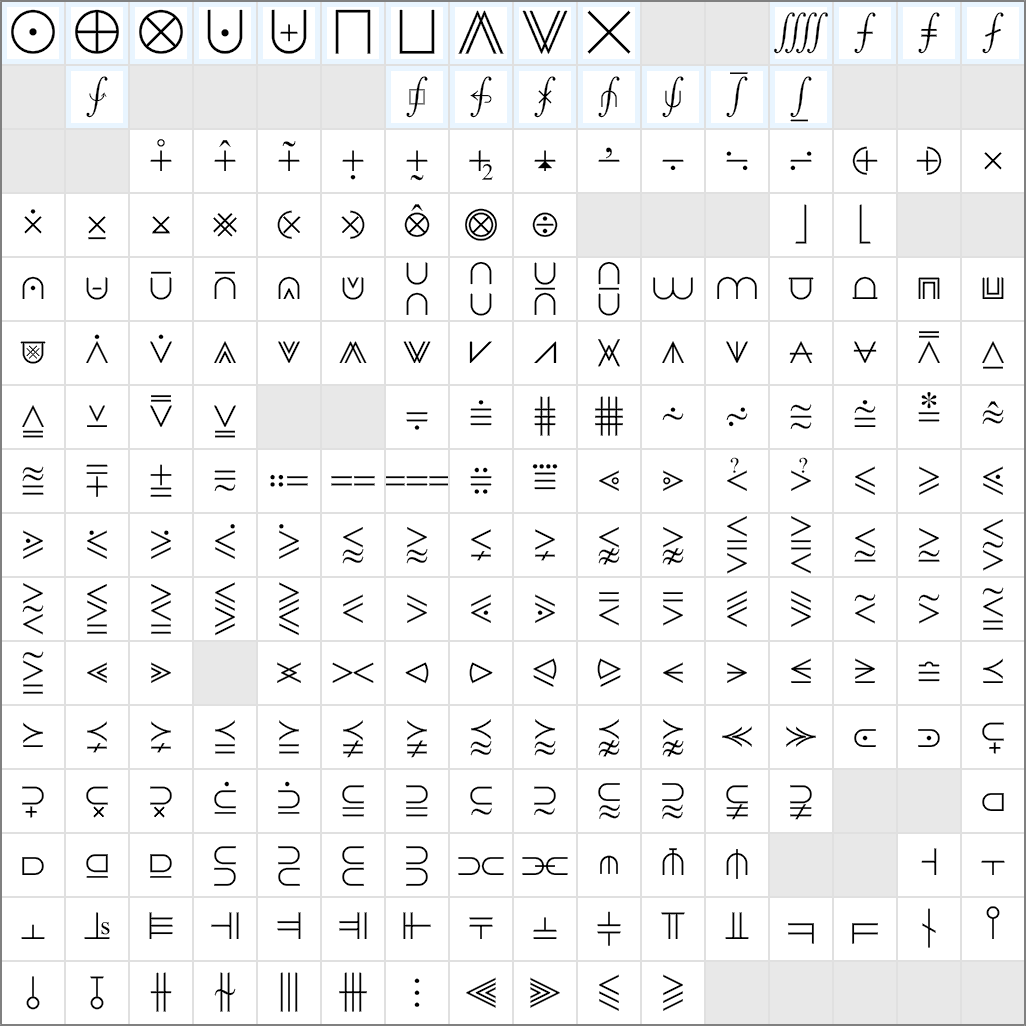
The full set of characters in the Radical Font can be seen on its documentation page. There are no letters, numbers, or common symbols like percent or ampersand, just mathematical and scientific characters. About two thirds of them are concentrated in the Unicode blocks shown below, which include many mathematical operators, a wide variety of relations, and a sampling of the huge number of arrows defined by Unicode.
U+2190..U+21FF
U+2200..U+22FF
U+2900..U+29FF
U+2A00..U+2AFF
The Unicode standard also defines a bunch of symbols that appear in specific areas of science, and they added some new stuff in Unicode 17, which was released in September 2025. The Radical font contains support for these latest additions in the most recent release of Radical Pie.
The number of Unicode characters dedicated to chemistry has always been somewhat light. Before Unicode 17, there were a couple variations of a benzene ring, and that’s about it. Then a proposal for new chemistry symbols was incorporated into the standard, giving us a set of characters that’s a bit larger. A new standard state symbol was added at U+1CEF0 to replace the misuse of U+29B5, which is close in appearance but not quite the right shape. Nine new long arrows were also added at U+1F8D0 through U+1F8D8 for use in chemical equations. (With the exception of the last one of these, the arrow builder in Radical Pie could already create these as stretchable arrows with labels above or below.) The full set of characters specifically intended for chemistry included in the Radical font are listed in the following table.
The mhchem LaTeX package was the inspiration for the new arrows added in Unicode 17. This package also defines several symbols for chemical bonds that do not appear in Unicode, but I felt it would be useful to have them in Radical Pie. Since Unicode does not define code points for them, the ten bond symbols shown in the following table had to be placed in one of the private use areas (PUA) of the code space.
| Unicode | Character | Description |
|---|---|---|
| U+1CEF0 |  |
Standard state |
| U+23E3 |  |
Benzene 1 |
| U+232C |  |
Benzene 2 |
| U+1F8D0 |  |
Long rightwards arrow over long leftwards arrow |
| U+1F8D1 |  |
Long rightwards harpoon over long leftwards harpoon |
| U+1F8D2 |  |
Long rightwards harpoon above short leftwards harpoon |
| U+1F8D3 |  |
Short rightwards harpoon above long leftwards harpoon |
| U+1F8D4 |  |
Long leftwards harpoon above short rightwards harpoon |
| U+1F8D5 |  |
Short leftwards harpoon above long rightwards harpoon |
| U+1F8D6 |  |
Long rightwards arrow through X |
| U+1F8D7 |  |
Long rightwards arrow with double slash |
| U+1F8D8 |  |
Long left right arrow with dependent lobe |
| U+EE30 (PUA) |  |
Single bond |
| U+EE31 (PUA) |  |
Double bond |
| U+EE32 (PUA) |  |
Triple bond |
| U+EE33 (PUA) |  |
Quadruple bond |
| U+EE34 (PUA) |  |
Partial single bond |
| U+EE35 (PUA) |  |
Partial double bond 1 |
| U+EE36 (PUA) |  |
Partial double bond 2 |
| U+EE37 (PUA) |  |
Partial triple bond 1 |
| U+EE38 (PUA) |  |
Partial triple bond 2 |
| U+EE39 (PUA) |  |
Partial triple bond 3 |
The Unicode standard includes a surprising number of astronomical symbols, and 21 more were added in Unicode 17. Nowadays, some of these symbols have more astrological meaning rather than astronomical, but they are still historically relevant. The entire set includes symbols for the planets, dwarf planets, major asteroids, and a few objects in the outer solar system called centaurs.
Symbols for the sun, moon, and planets are shown in the following table. These were among the first glyphs I drew for the Radical font because I was having a hard time finding them with the right style and stroke weights in an existing font. Of all the astronomical symbols shown here and below, these are the most likely to be used in scientific writing because they often appear as subscripts when describing the mass, radius, or some other property of a celestial body.
| Unicode | Character | Description |
|---|---|---|
| U+2609 |  |
Sun |
| U+263E |  |
Left moon |
| U+263D |  |
Right moon |
| U+263F |  |
Mercury |
| U+2640 |  |
Venus |
| U+1F728 |  |
Earth |
| U+2641 |  |
Earth variant |
| U+2642 |  |
Mars |
| U+2643 |  |
Jupiter |
| U+2644 |  |
Saturn |
| U+26E2 |  |
Uranus |
| U+2645 |  |
Uranus variant |
| U+2646 |  |
Neptune |
| U+2BC9 |  |
Neptune variant |
The following table shows the symbols for the dwarf planets in the Radical font, including the five officially recognized dwarf planets and four more that are likely candidates for dwarf planet classification in the future.
| Unicode | Character | Description |
|---|---|---|
| U+2647 |  |
Pluto |
| U+2BD3 |  |
Pluto variant |
| U+2BF0 |  |
Eris |
| U+2BF1 |  |
Eris variant |
| U+26B3 |  |
Ceres |
| U+1F77B |  |
Haumea |
| U+1F77C |  |
Makemake |
| U+1F77D |  |
Gonggong |
| U+1F77E |  |
Quaoar |
| U+1F77F |  |
Orcus |
| U+2BF2 |  |
Sedna |
The 21 new astronomical symbols added to Unicode 17 all represent major asteroids, expanding the handful of symbols that were previously encoded. The Radical font now contains each and every one, and they are shown in the following table. I realize these symbols are very obscure and their use in scientific literature will be extremely rare, but it was still fun to make glyphs for them.
| Unicode | Character | Description |
|---|---|---|
| U+26B4 |  |
2 Pallas |
| U+26B5 |  |
3 Juno |
| U+26B6 |  |
4 Vesta |
| U+1F778 |  |
5 Astraea |
| U+2BD9 |  |
5 Astraea variant |
| U+1CEC0 |  |
6 Hebe |
| U+1CEC1 |  |
7 Iris |
| U+1CEC2 |  |
8 Flora |
| U+1CEC3 |  |
9 Metis |
| U+2BDA |  |
10 Hygiea |
| U+1CEC4 |  |
11 Parthenope |
| U+1F77A |  |
11 Parthenope variant |
| U+1CEC5 |  |
12 Victoria |
| U+1CEC6 |  |
13 Egeria |
| U+1CEC7 |  |
14 Irene |
| U+1CEC8 |  |
15 Eunomia |
| U+1CEC9 |  |
16 Psyche |
| U+1CECA |  |
17 Thetis |
| U+1CECB |  |
18 Melpomene |
| U+1CECC |  |
19 Fortuna |
| U+1CECD |  |
26 Proserpina |
| U+2BD8 |  |
26 Proserpina variant |
| U+1CECE |  |
28 Bellona |
| U+1CECF |  |
29 Amphitrite |
| U+1CED0 |  |
35 Leukothea |
Finally, the Unicode standard currently includes symbols for 14 of the 88 constellations. Twelve of these come straight from the zodiac. The ecliptic intersects one more constellation, Ophiuchus, and that is sometimes included as the 13th sign of the zodiac, so it was put into Unicode as well. The 14th constellation in the table, Lyra, has the same symbol as the alternate for the asteroid 11 Parthenope, which was just added to Unicode 17 as U+1F77A. The remaining 74 constellations are not encoded, but there is a proposal in the works to get them into the standard. [EDIT: The constellations in this proposal have been added to the Radical font in version 1.7 beginning at U+EF00 in the private use area.]
| Unicode | Character | Description |
|---|---|---|
| U+2648 |  |
Aries |
| U+2649 |  |
Taurus |
| U+264A |  |
Gemini |
| U+264B |  |
Cancer |
| U+264C |  |
Leo |
| U+264D |  |
Virgo |
| U+264E |  |
Libra |
| U+264F |  |
Scorpius |
| U+2650 |  |
Sagittarius |
| U+2651 |  |
Capricornus |
| U+2652 |  |
Aquarius |
| U+2653 |  |
Pisces |
| U+26CE |  |
Ophiuchus |
| U+1F77A | |
Lyra |
In Radical Pie, many of the characters shown above are available in the symbol palettes,
and all of them can be accessed in the Insert Character dialog.
For each of the astronomical symbols, a TeX identifier is also available so, for example,
it’s possible to just type \Mars, \Ceres, or \Lyra followed by a space in the editor
to obtain the corresponding symbol.